

Wait… nouns have genders? If you’re learning Serbian, you’ve probably had this exact reaction.
In Serbian, every noun belongs to one of three grammatical genders: masculine, feminine, or neuter. And before you start thinking, “Great, another thing to memorize,” take a breath! There are some surprisingly simple patterns that can help you spot a noun’s gender at a glance.
In this guide, we’ll break down how to identify gender, look at common noun endings, explore a few exceptions, and share practical tips to make Serbian grammar feel less like a puzzle and more like a piece of cake.
As we previously said, Serbian nouns come in three grammatical flavors: masculine, feminine, and neuter.
But noun gender doesn’t just sit quietly in the background. You’ll notice it most often in adjectives, pronouns, and past-tense verb forms. For example:
lep grad – beautiful city
lepa kuća – beautiful house
lepo selo – beautiful village
Notice how lep changes depending on the gender of the noun? That little ending is doing some serious grammar work!
The easiest approach is to learn each new noun together with its gender. Instead of memorizing grad on its own, think lep grad or simply “grad, masculine.”
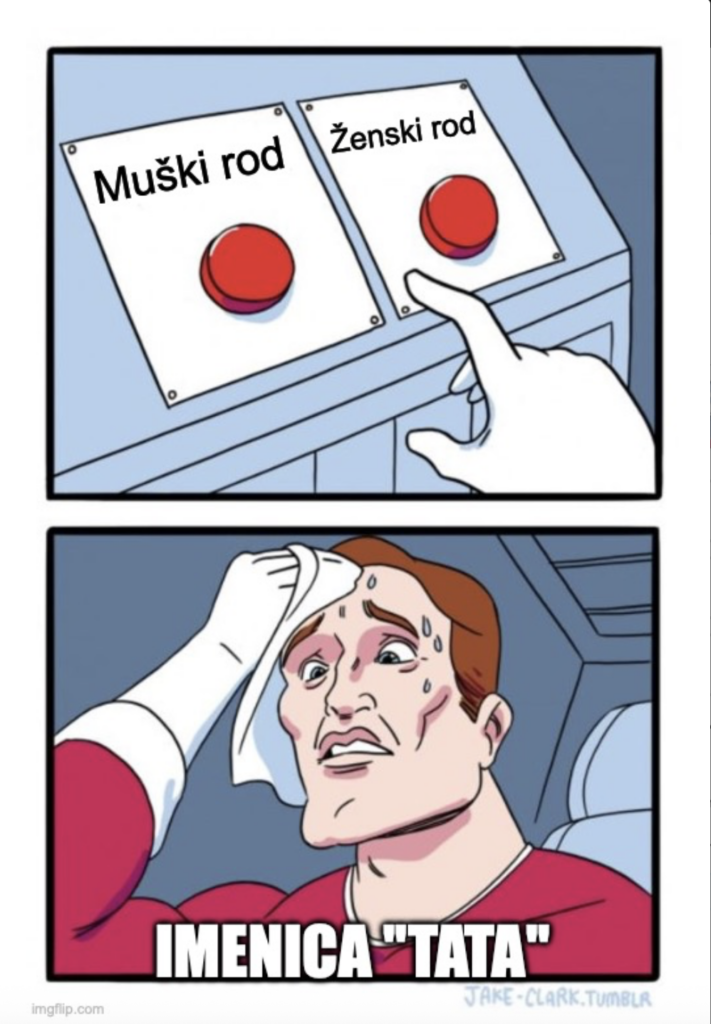
So, how can you actually tell the gender of a Serbian noun? The short answer: look at the ending. While there are exceptions (because Serbian grammar likes to keep us humble), noun endings can give you a very good starting point.
Masculine nouns (imenice u muškom rodu) most often end in a consonant, with no vowel at the end:
muškarac – man
grad – city
dan – day
jezik – language
student – student
Feminine nouns (imenice u ženskom rodu) most commonly end in -a:
žena – woman
kuća – house
škola – school
knjiga – book
Neuter nouns (imenice u srednjem rodu) most commonly end in -o or -e:
dete – child
selo – village
mesto – place
more – sea
sunce – sun
Teacher tip: Think of these endings as helpful clues, not ironclad rules. They’re great for making an educated guess, but learning the gender along with every new noun is your best strategy.
Serbian grammar has a few plot twists, so don’t let an exception catch you completely off guard!
Serbian wouldn’t be Serbian without a few exceptions to keep things interesting! While noun endings are a fantastic shortcut, they’re not a magic crystal ball. Sometimes, a noun simply refuses to play by the usual rules.
For example, feminine nouns such as noć (night), stvar (thing), reč (word) and ljubav (love) don’t end in -a. On the other hand, masculine words like tata (dad), deda (grandpa), and sudija (judge) do end in -a, even though -a is usually a big clue that a noun is feminine.
And here’s another curveball: grammatical gender doesn’t always have anything to do with real-world gender. Kuća (house) isn’t biologically female, and grad (city) isn’t biologically male – Serbian grammar simply assigns them different genders.
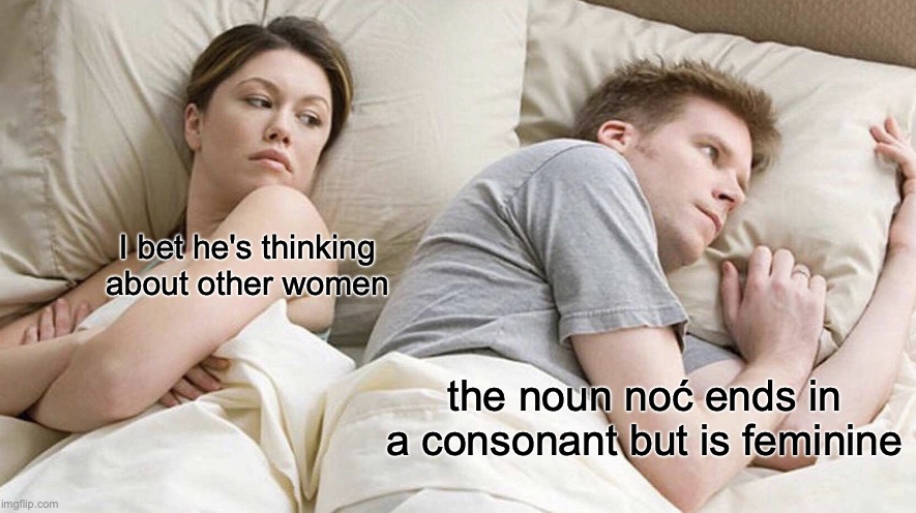
At this point, you might be thinking: “Okay, but why should I care about noun gender?” Fair question! It’s worth knowing the gender of a noun because it can change the form of the words that go with it.
Take these examples:
dobar grad – good city
dobra škola – good school
dobro mesto – good place
See how dobar, dobra, and dobro change depending on the noun’s gender? Once you know the gender, it becomes much easier to get these endings right and avoid sentences that sound a little “off” in Serbian.
In other words, learning noun gender now makes future Serbian grammar much easier!
Learning noun gender becomes much easier with a few simple habits.
Don’t memorize just knjiga. Train yourself to think knjiga – feminine. Even better, learn it in a short phrase such as nova knjiga (new book).
Use the basic shortcut:
consonant → usually masculine
-a → usually feminine
-o / -e → usually neuter
These patterns won’t solve every noun, but they’ll help you make a good first guess.
It can be easier to remember a noun when you see it with a word that changes with its gender. Instead of learning kuća on its own, try learning velika kuća. A few simple examples:
velika kuća – big house
dobar restoran – good restaurant
malo selo – small village
This gives you a bit of context and helps you get used to the adjective endings at the same time. After a while, you’ll start noticing what sounds right without having to stop and think about the grammar.
Adjectives are great clues. When you repeatedly see dobar, dobra, and dobro, the connection between adjectives and noun gender starts to become automatic.
Gender takes practice. You’ll get things wrong sometimes, and that’s completely normal. Focus on recognizing patterns, keep noticing how native speakers use words, and gradually the correct forms will become automatic.
Here’s the beginner-friendly version to keep in mind. These are general patterns, not absolute rules, so always watch out for exceptions.
| Usually ends in… | Gender | Example |
| Consonant | Masculine (muški rod) | okean (ocean) |
| -a | Feminine (ženski rod) | reka (river) |
| -o / -e | Neuter (srednji rod) | more (sea) |
Now it’s your turn! Based on the noun endings, can you guess the gender of these Serbian nouns?
prozor – window
škola – school
jezero – lake
telefon – phone
voda – water
knjiga – book
Bonus challenge: Try adding an adjective to each noun. For example: veliki prozor, velika škola, veliko jezero. Can you see the pattern?
Answers:
prozor – masculine
škola – feminine
jezero – neuter
telefon – masculine
voda – feminine
more – neuter
Grammatical gender may seem strange at first, especially if your native language doesn’t use noun gender. But once you get familiar with the patterns, it becomes much easier to recognize.
Once you start seeing the patterns, gender in Serbian becomes much less mysterious – and a lot more manageable.
Want to take your Serbian grammar a step further? Explore more Serbian grammar resources from Go Speak Serbian, or join our Serbian group classes starting in September and learn with guidance, practice, and plenty of real-life examples.