
If you’re coming from English, making nouns plural feels like a total no-brainer: just slap an -s on the end and call it a day. Serbian nouns, however, like to keep you on your toes!
But don’t worry! Once you understand gender and the most common plural patterns, Serbian nouns become much easier to handle.
In this guide, we’ll cover the rules, tricky exceptions, and give you some practice along the way.
Before we turn one noun into a whole crowd, let’s get acquainted with the two little rules that run the show: gender and number. Get friendly with them, and Serbian nouns stop feeling like a puzzle.
Every Serbian noun has a grammatical gender: masculine (muški rod), feminine (ženski rod), or neuter (srednji rod).
| Gender | Serbian | English |
| Masculine | grad | city |
| Feminine | knjiga | book |
| Neuter | selo | village |
Grammatical gender isn’t always about whether something is biologically male or female. For example, kuća (house) is feminine, while stan (apartment) is masculine. Think of grammatical gender as a category rather than a description of the thing itself.
Serbian nouns can talk about one thing or more than one thing, just like they do in English. So you might say:
jedna knjiga — one book
dve knjige — two books
Simple enough so far. But what happens to the noun when one turns into two, three, or more? That’s where Serbian starts doing things a little differently.
The good news? There are patterns. The slightly less good news? Serbian occasionally likes to surprise you. Let’s see how it works.
Ready for the good stuff? The plural form of many Serbian nouns follows a pattern based on gender and the noun’s ending. That means you don’t have to memorize every single plural from scratch – hooray!
Here are the three basic patterns to know:
| Noun type | Common plural ending | Example |
| Masculine: consonant-ending | -i / stem change | grad → gradovi |
| Feminine: ending in -a | -e | knjiga → knjige |
| Neuter: ending in -o/-e | -a | selo → sela |
Many masculine nouns end in a consonant and form their plural with -i:
student → studenti (student → students)
telefon → telefoni (phone → phones)
But Serbian couldn’t resist adding a little plot twist. Some masculine nouns change their stem as well:
grad → gradovi (city → cities)
pas → psi (dog → dogs)
So while -i is a useful starting point, don’t expect it to work like an automatic “add to cart” button for every masculine noun.
For many feminine nouns ending in -a, the basic rule is nice and friendly:
-a → -e
For example:
knjiga → knjige (book → books)
žena → žene (woman → women)
kuća → kuće (house → houses)
škola → škole (school → schools)
Many neuter nouns ending in -o or -e form the plural with -a:
selo → sela (village → villages)
pismo → pisma (letter → letters)
more → mora (sea → seas)
These patterns will take you surprisingly far. Just remember that Serbian nouns don’t always play by the rules – some have stem changes or completely irregular plurals. We’ll talk about those troublemakers next.

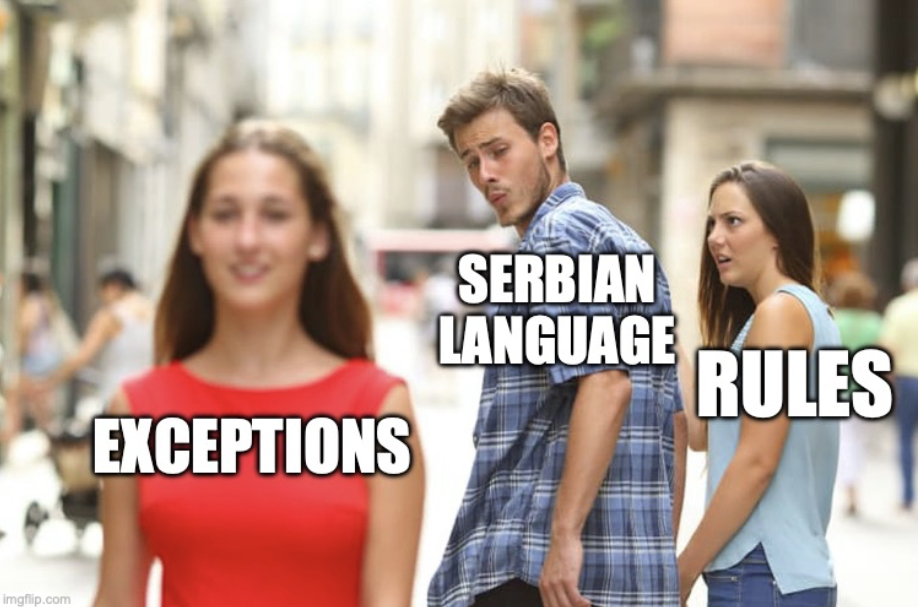
And now we meet the Serbian nouns that looked at the grammar rules and said, “No, thanks.”
Some very common nouns have plural forms that you simply can’t predict by adding an ending. Instead, the word changes in a way you’ll need to learn as part of your vocabulary.
| Singular | Plural | English |
| čovek | ljudi | person/people |
| dete | deca | child/children |
| brat | braća | brother/brothers |
| gospodin | gospoda | gentleman/gentlemen |
These are known as irregular plural forms, and they’re especially important because you’ll encounter these words all the time.
Not every Serbian noun fits neatly into the “regular” or “irregular” box. A few have their own little quirks, and they’re worth knowing.
Some Serbian nouns are normally used only in the plural, even when we’re talking about a single object or pair:
vrata – doors
makaze – scissors
pantalone – pants
naočare – glasses
Don’t worry about memorizing complicated rules here. Just learn these words in the form you’ll actually use.
The opposite also happens. Some nouns are normally used in the singular, particularly when they refer to substances or abstract ideas:
voda – water
šećer – sugar
brašno – flour
You’ll occasionally encounter different forms depending on the context, but for everyday Serbian nouns, the important thing is to recognize which words are normally treated as singular.
And that’s really all you need for now. Serbian grammar has plenty more surprises in store, but this article isn’t trying to become War and Peace of noun grammar.
Just when you thought you had Serbian plurals figured out, numbers arrive with a little plot twist.
Compare these examples:
jedna knjiga – one book
dve knjige – two books
tri knjige – three books
pet knjiga – five books
Notice anything? After pet, knjiga goes back to its singular-looking form. So, while numbers and plural nouns are closely connected, the noun form you use after a number isn’t always the same as the regular plural.
You don’t need to crack the entire Serbian number code just yet. The important thing to remember is that dve knjige and pet knjiga take different forms.
Ready to flex those grammar muscles? No peeking at the answers yet. 😉
Write the plural form of each noun:
knjiga →
žena →
selo →
grad →
student →
Can you pair each singular noun with its plural soulmate?
Singular:
Plural:
Complete the sentence with the correct form:
Imam dve ______. (knjiga)
Exercise 1
knjiga → knjige
žena → žene
selo → sela
grad → gradovi
student → studenti
Exercise 2
dete → deca
brat → braća
kuća → kuće
čovek → ljudi
more → mora
Exercise 3
Imam dve knjige.
I have two books.
Good news: you don’t need a photographic memory (or a lifetime subscription to a grammar textbook) to master Serbian plurals. A few smart little habits will do the heavy lifting for you.
Learn ’em as a pair. Singular first, plural right behind it, like they’re holding hands:
grad → gradovi
žena → žene
selo → sela
That’s it. That’s the trick. You stop trying to “remember” the plural later, because you never met it alone in the first place.
Some of the most common Serbian nouns are also the ones that refuse to follow the rules. Make these a priority:
čovek → ljudi
dete → deca
brat → braća
The more you encounter them, the more natural they’ll become.
Instead of memorizing vocabulary in isolation, put it to work:
Ovo je knjiga.
This is a book.
Ovo su knjige.
These are books.
You’ll practice plurals while naturally picking up other parts of Serbian grammar, too. Two birds, one grammar lesson!
When you learn Serbian, consistency beats cramming. A short Serbian lesson or a few minutes of practice every day is often more useful than trying to conquer an entire grammar book in one weekend.
Read, listen, speak, and use your new words regularly. Whether you’re taking Serbian lessons or trying to learn Serbian online, regular exposure will help those plural forms stick.
With structured lessons and a real Serbian teacher in your corner, you can build vocabulary and grammar at the same time, raise your hand the second something makes you go “wait… what?” (and trust us, something will), and actually – gasp – speak Serbian in real conversations instead of just thinking about it really hard.
So, instead of wrestling with grammar solo while 47 browser tabs scream for your attention, why not learn with a little backup? Join Go Speak Serbian’s online classes and give your Serbian the workout it’s been begging for. 💪