
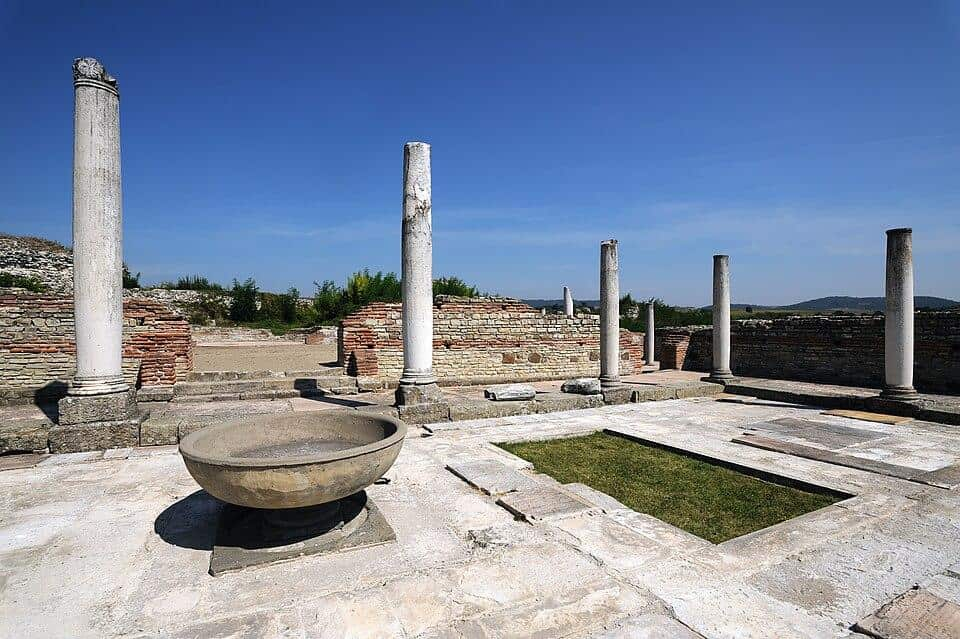
What do Roman emperors, ancient ruins, and learning Serbian have in common? More than you’d expect – and considerably more fun than a dusty history textbook.
If you’re ready to explore Serbia beyond Belgrade, pack your curiosity (and maybe an imaginary toga) and head east to Felix Romuliana.
This isn’t just another pile of old stones. It’s a full-on Roman imperial statement: fortified walls, grand palaces, temples, mosaics, and enough ancient drama to make you wonder whether someone forgot to turn off the time machine.
Gladiators? Sadly, not included. Ancient history and Serbian vocabulary? Absolutely.
Did you know Serbia once had its very own Roman emperor’s luxury residence?
No, we’re not talking about a modest holiday villa with a pool and a questionable barbecue setup. We’re talking about Felix Romuliana, a sprawling fortified palace complex built for Emperor Galerius in the late 3rd and early 4th centuries.
Tucked away near Zaječar in eastern Serbia, the site was named after Galerius’s mother, Romula. And because Roman emperors apparently didn’t do anything by halves, Galerius built it as both an imperial residence and a monument to his own achievements. A tribute to Mum and a personal flex? Very Roman.
But Felix Romuliana was more than an ancient version of “look at my house.” Behind its impressive walls and towers stood palaces, temples, ceremonial spaces, baths, and richly decorated rooms. Its mosaics, sculptures, and architectural remains still hint at just how spectacular the place once was.
Today, it’s one of Serbia’s most important archaeological sites – and a UNESCO World Heritage Site since 2007. In other words, you can experience serious Roman history without booking a flight to Italy.
And since we’re already travelling back in time, let’s pick up a few Serbian words along the way.
| Serbian | English |
| Stari Rim | Ancient Rome |
| rimski car | Roman emperor |
| palata | palace |
| ruševine | ruins |
| arheološko nalazište | archaeological site |
| nasleđe | heritage |
Here’s a simple sentence to practice: Ovo je rimska palata. (This is a Roman palace.) Congratulations! You’ve just added a little Roman history to your Serbian vocabulary. Caesar would be proud.
So, what exactly awaits you at Felix Romuliana?
Quite a lot, actually. This is not a random collection of ruins in a field. It’s a chance to step into the world of a Roman imperial residence nearly 1,700 years ago – and to discover that Roman interior design was seriously extra.
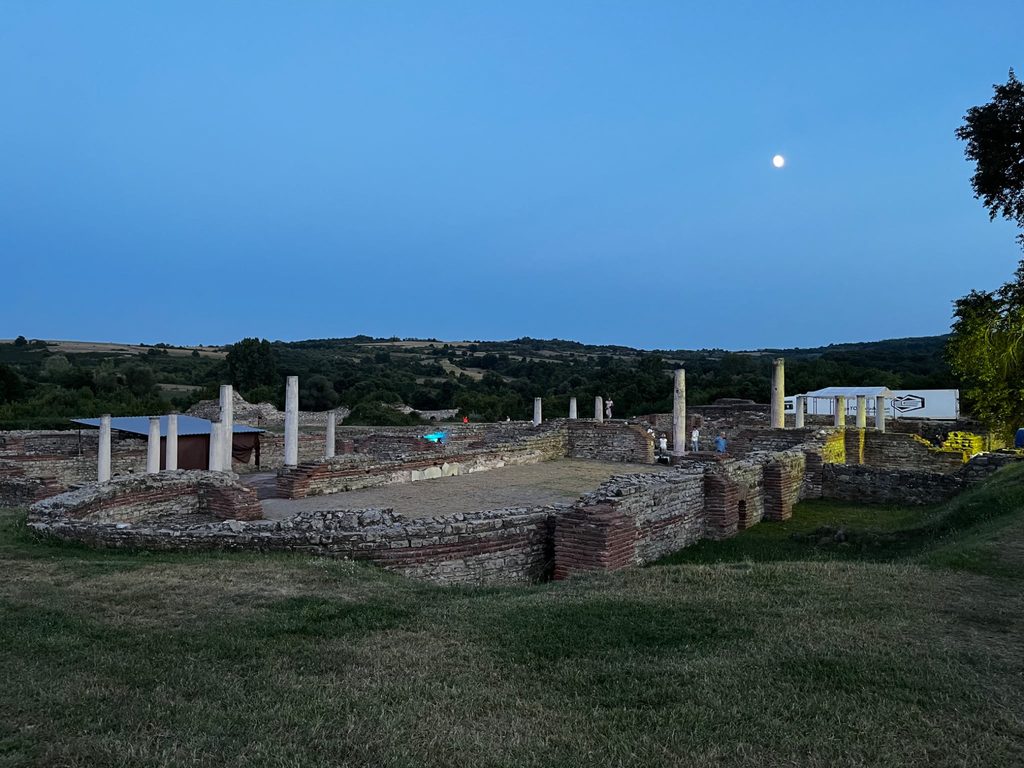
As you wander through the site, you’ll pass the remains of fortified walls and monumental gates that once protected the complex. Inside, you can explore the foundations of imperial palaces, temples, and ceremonial buildings. Much of the original architecture has vanished, but the surviving details still tell one very impressive story.
One of the absolute highlights? The floor mosaics. Think intricate patterns, mythological figures, and craftsmanship that has somehow survived the centuries. Keep an eye out for Medusa, the famous figure from Greek mythology whose gaze could turn people to stone.
Talk about an unconventional home-security system.
As you explore, try describing what you see in Serbian. A few handy adjectives:
| Serbian | English |
| star/stara | old |
| drevan/drevna | ancient |
| impresivan/impresivna | impressive |
| prelep/prelepa | beautiful |
| veliki/velika | big/large |
| zanimljiv/zanimljiva | interesting |
Now, let’s put those words into practice:
Ovo je drevna palata. – This is an ancient palace.
Mozaici su prelepi. – The mosaics are beautiful.
Ovo mesto je veoma zanimljivo. – This place is very interesting.
See? You don’t need to be a Roman emperor to appreciate Felix Romuliana. And you definitely don’t need perfect Serbian to describe it.
You don’t need to speak fluent Serbian to enjoy exploring the country. In fact, learning just a handful of useful words can turn an ordinary sightseeing trip into something far more memorable – and might earn you a few impressed nods from locals.
And where better to expand your vocabulary than somewhere with nearly 2,000 years of history?
Visiting an archaeological site, wandering through a museum or talking about Serbia’s past? Here are some words that will come in handy:
| Serbian | English |
| istorija | history |
| muzej | museum |
| ulaz | entrance |
| ulaznica | admission ticket |
| vodič | guide |
| posetilac | visitor |
| izložba | exhibition |
| iskopavanje | excavation |
| galerija | gallery |
You can also practise with short sentences:
Volim istoriju. – I love history.
Gde je muzej? – Where is the museum?
And here’s a bonus: ruševine means ruins, while rušiti means to demolish or tear down. Learn one, and you’ve already got a head start on the other.
The best part? This vocabulary won’t retire after Felix Romuliana. Serbia is packed with museums, fortresses, monasteries, and archaeological sites just waiting to become your next language classroom.
Knowing a few words is one thing. Using them while standing at a ticket counter, trying not to panic, is a whole different adventure.
Don’t worry – we’ve got you covered. Whether you’re visiting Felix Romuliana, exploring a museum in Belgrade, or checking out a medieval fortress somewhere else in Serbia, these phrases will help you find your way.
Nobody wants to spend their holiday playing charades at the ticket counter. Here are a few expressions to make things easier:
| Serbian | English |
| Dobar dan! | Good afternoon! |
| Jednu ulaznicu, molim. | One ticket, please. |
| Koliko košta ulaznica? | How much is the ticket? |
| Da li imate popust za studente? | Do you offer a student discount? |
| Mogu li da platim karticom? | Can I pay by card? |
Once you’ve got your ticket, you may want a few details before setting off on your historical adventure:
| Serbian | English |
| Gde je ulaz? | Where is the entrance? |
| Kada se zatvara muzej? | When does the museum close? |
| Da li postoji vodič na engleskom? | Is there an English-speaking guide? |
| Koliko traje obilazak? | How long does the tour take? |
| Da li je fotografisanje dozvoljeno? | Can I take pictures? |
Sometimes, the best way to practise a language is simply to start talking. You don’t need to deliver a lecture on the fall of the Roman Empire. A compliment or a simple question is a perfectly good beginning.
| Serbian | English |
| Ovo mesto je prelepo! | This place is beautiful! |
| Veoma je zanimljivo. | It’s very interesting. |
| Možete li da mi preporučite još neko mesto? | Can you recommend another place? |
| Hvala na pomoći! | Thank you for your help! |
A quick grammar tip before you go: molim means please, hvala means thank you, and Možete li…? is a polite way to ask, Could you…? These little expressions work almost everywhere – from museums and cafés to shops and train stations.
Exploring ancient palaces and picking up new vocabulary? Honestly, not a bad way to spend an afternoon.
But here’s the real takeaway: learning Serbian doesn’t have to mean hours of grammar drills or staring blankly at a textbook. (Though a little grammar never hurt anyone – promise.)
The best way to learn is to connect the language with what you already love.
Love history? Explore Serbia’s fascinating past. Into music? Listen to Serbian songs and follow the lyrics. A foodie? Learn how to order your favourite dishes in Serbian. Each new experience is an opportunity to learn a word, practice a phrase or start a conversation.
And remember: mistakes are part of the process. You might mix up a word or forget a verb ending now and then. That’s completely normal. The important thing is to keep going.
Join Go Speak Serbian’s online classes and turn:
Želim da naučim srpski.
I want to learn Serbian.
into:
Govorim srpski!
I speak Serbian!
Your next adventure starts with a simple: Zdravo!